

Crawlability, indexing, canonicals, redirects, architecture, structured data and page experience, audited, prioritised by impact and fixed by the same developers who found the problems.
Tell us what is happening and we will reply with a clear next step.
Technical SEO is making sure search engines can discover, crawl, render, understand and index the pages you want found, through site architecture, internal linking, canonicals, redirects, sitemaps, robots rules, structured data and page experience, so your content can compete on its merits.
Technical SEO removes obstacles. It doesn’t write your content or earn links, and it can’t make a page rank that doesn’t deserve to. What it does is make sure good pages aren’t held back by things like a misconfigured canonical, a crawl trap generating thousands of junk URLs, or important pages buried six clicks deep.
It’s distinct from on-page SEO (what each page says and how it’s structured), local SEO (visibility for location-based searches) and Search Console fixes (diagnosing the reports Google sends).
A page has to pass every stage. It can fail to be discovered (no links, not in the sitemap), crawled (blocked by robots.txt, server errors, crawl budget wasted elsewhere), rendered (content only appears after JavaScript that fails), or indexed (duplicate, noindex, canonical pointing elsewhere, too thin). Our audit checks each stage.
| Area | What we check |
|---|---|
| Crawlability | robots.txt, server responses, crawl traps (filters, calendars, parameters), JavaScript-dependent links |
| Indexability | noindex tags, canonicals, duplicates, thin and near-empty pages, index coverage vs. sitemap |
| Architecture | Click depth, orphan pages, navigation, breadcrumbs, internal link distribution |
| Redirects & status codes | Chains, loops, 302s that should be 301s, broken internal links, soft 404s |
| Sitemaps | Only canonical, indexable, 200-status URLs; correct submission in Search Console |
| Structured data | Valid, relevant schema that matches visible content |
| Page experience | Core Web Vitals, mobile usability, HTTPS, intrusive interstitials |
| Rendering | Whether key content and links exist in the HTML or depend on JavaScript |
Where server access is available, we also look at log files to see what search engine crawlers actually request, which often reveals wasted crawling no other tool shows.
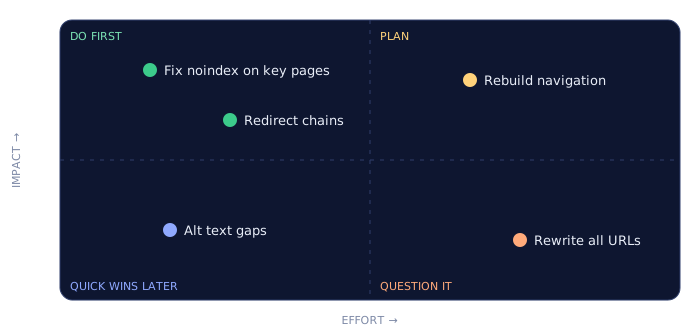
Automated SEO tools produce long lists of “issues”, many of them trivial. Our report ranks findings by likely impact and effort, explains each in plain English, and is clear about what you can safely ignore. You get a short list of what to fix first, not a spreadsheet that never gets actioned.
Many audits end with a PDF. Ours can end with the fixes done: redirect rules written, templates corrected, canonical and noindex logic fixed in WordPress, sitemaps cleaned, structured data added and validated, internal links improved. Because we’re developers, the same team that finds the issue can fix it on staging, test it and deploy it.
SEO plugin configuration, template fixes, faceted navigation and pagination handled properly.
Organization, breadcrumbs, articles, products and services, valid and matched to visible content.
We record a baseline before changes: indexed pages, crawl stats, Core Web Vitals, and search performance for the pages affected. After fixes, we compare. Technical improvements often show in Search Console within days to weeks as Google recrawls; ranking and traffic changes take longer and depend on content and competition too, so we report them honestly rather than claiming every movement.
No one can guarantee rankings. We’ll tell you what we fixed, what changed, and what we think will matter next.
A WooCommerce store has around 600 products, but Search Console reports over 40,000 URLs discovered. The audit finds that layered navigation filters create a crawlable URL for every combination of size, colour and price, and that these are linked from every category page. Googlebot spends most of its time crawling filter combinations, while new products take weeks to be indexed.
Filter links are changed so combinations aren’t crawlable, parameters are handled consistently, filter pages get a noindex where appropriate, and the sitemap is cleaned to list only canonical product and category URLs. Over the following weeks, discovered-but-not-indexed counts fall and new products are indexed faster.
Composite example to explain the process. Not a specific client.
For coverage, crawl stats and performance data.
To implement fixes in templates, settings and plugins.
For server logs, redirects and robots.txt.
To measure the effect on traffic and conversions.
Technical SEO is about whether search engines can crawl and index the site properly. On-page SEO is about what each page says and how well it matches what people search for.
Small sites have fewer issues, but one misconfiguration (like a site-wide noindex or broken canonicals) can still hide everything. A lighter review is often enough.
Technical fixes can show in Search Console within days to weeks. Traffic changes take longer and depend on content and competition.
Yes. Implementation is usually part of the scope, done on staging and deployed.
No. Anyone who guarantees rankings is guessing. We remove obstacles and measure what changes.
info@webexpert.solutions · +92 345 7723858 · Faisalabad, Pakistan · Serving the UAE, US, UK & Canada